
No Excuses: How to Build, Scale, and Win in Hard Tech
Kyle Adkins, Head of Strategic Operations and Finance
The Real Blueprint for Hard Tech Success
Hard tech startups occupy the critical frontier of industrial progress, from reshoring production to securing strategic access to the energy and materials needed for a more abundant future. Yet promising industrial innovations stall out before reaching commercialization at an unacceptably higher rate than the broader startup ecosystem.
It doesn’t have to be this way! The “Valley of Death” refers more to a yawning chasm of excuses than a diagnosis. Yes, many capital-intensive startups flounder and struggle with the higher upfront investment required to reach commercial viability, but plenty have also succeeded. The question isn’t just why startups fail, but why some manage to win—and how we can engineer more victories.
Those that succeed are focused from day one on developing technology and building companies that deliver real economic value per dollar spent, not by leaning on government crutches, rich subsidies, or vague promises of economies of scale. They develop and build rapidly and iteratively with a maniacal focus on the cash they spend and an unmatched urgency to generate revenue.
At Terraform Industries, we are building a company that is deliberately structured to overcome these obstacles from the outset. Our mission, to produce cost-effective, carbon-neutral synthetic fuels, requires a fundamentally different approach to scale, capital deployment, and industrial execution. If we were to simply cargo cult other companies, we would not succeed. Instead we draw inspiration from past industrial giants who mastered the art of resource-constrained execution to help us exploit the unexpected bounty of cheap solar power.
Our rapid iteration, operational efficiency, and disciplined capital allocation mirror Henry Kaiser’s revolutionary wartime shipbuilding, with a vertically integrated supply chain and modular construction techniques. Our lean, high-speed development cycles allow us to make real progress without being bogged down by bureaucracy or inefficiency, much like Kelly Johnson’s Skunk Works, which used to be just across the road from our location in the Burbank castle!
Terraform is always eager to develop top talent, so if you are super smart and like the sound of rebuilding the entire foundation of our industrial civilization, shoot us a compelling one pager.
Energy, Growth, and Industrial Resurgence Matter
Energy abundance fuels human prosperity. The ability to produce materials, transport goods, and manufacture at scale underpins economic strength and national security. The U.S. must remain at the forefront of industrial capability, and so it must master the art of scaling transformative 21st century industrial technologies without succumbing to the waste and inefficiencies that doom so many promising ventures.
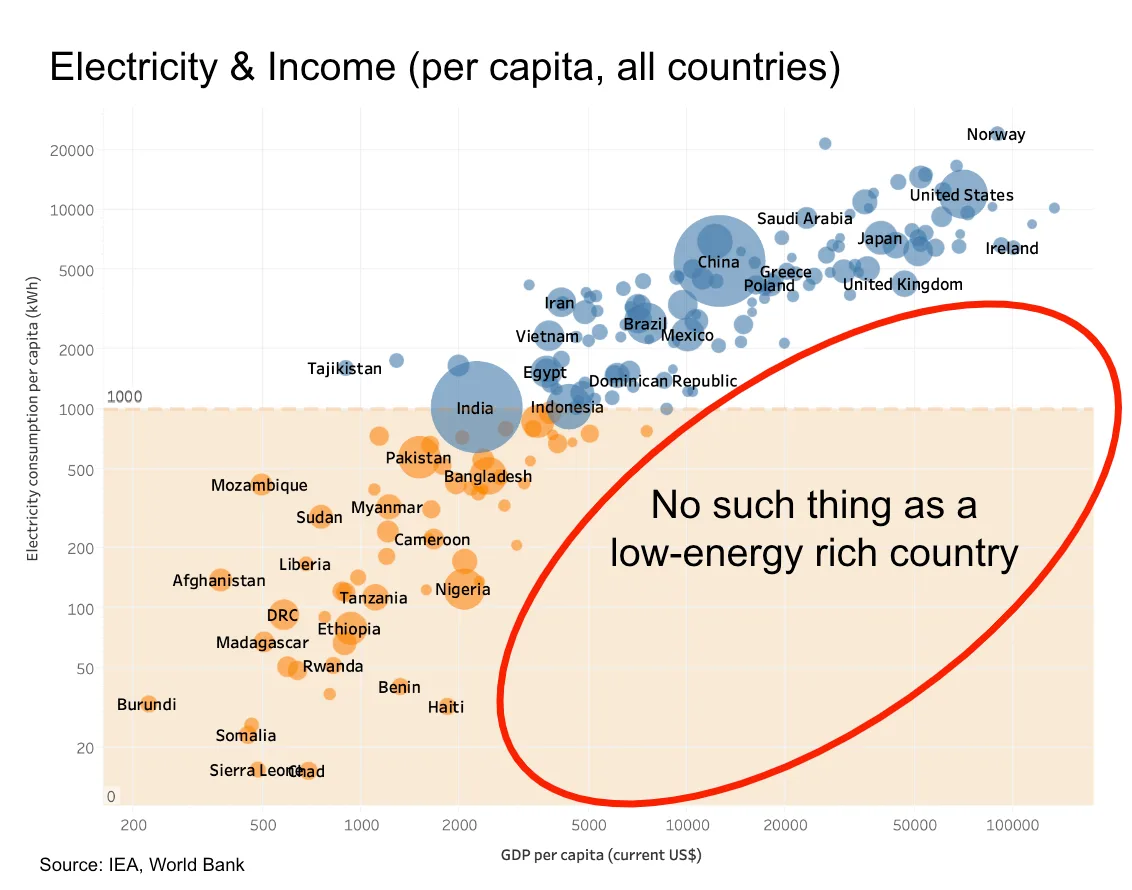
Yet, energy alone is not enough. The ability to harness it effectively—through superior industrial processes, vertically integrated supply chains, and cost-efficient manufacturing—is what determines economic leadership. Countries and companies that fail to innovate in these areas become dependent on fragile global markets and unreliable (or outright hostile) counterparties, while those that take control of their energy and production ecosystems secure strategic and economic independence. Terraform Industries is ensuring that America leads this new industrial age, not by relying on subsidies or regulations, but by building a scalable, market-driven model that works.
Hope is Not a Scaling Strategy
When faced with the failure of Cleantech 1.0/2.0 and the failure of the VC start up model to generalize much beyond SaaS, industry and government leaders will typically bemoan the “Valley of Death”. The Valley of Death is a purported capital-starved gap between the pilot-scale development of some new process, and the industrial scale investment necessary to see meaningful returns on investment. Instead of asking for funding to go from 0 to 1, hard-tech startups are often asking investors to trust them to go from 0 straight to 100 in a single step. Without that intermediate risk-happy and capital-flush customer and investor coming into perfect alignment, we are told, it’s nearly impossible to get the new industrial processes to escape velocity and so we are stuck with legacy plants and processes that somehow our grandparents were able to build with slide rules and high interest rates, and that just happen to make money.
These arguments rely too heavily on purported “economies of scale.” In this scenario, an academically-derived process may be demonstrated at pilot scale, retiring much of the perceived technical risk, while still remaining industrially immature and still being far away from positive unit economics. Perhaps this value deficit can be made up for by a purported willingness of the market to bear a massive green premium, despite this almost never occurring in practice.
Instead of charting a course that allows them to take smaller steps, rapidly iterate, and demonstrate measurable progress, we tend to see most companies instead devoting resources to extended solicitation of massive investments with technology and teams that are simply not prepared for it. While $10M can prove the science works, at least with the help of a team of PhDs, commercial viability may still be an afterthought.
We know from experience that, for example, chip and car manufacturing achieve low unit costs through enormous, capital intensive mass production factories, while container ships achieve low unit costs through enormous, capital intensive ships. It’s not too hard to cook up an Excel model that shows that the piloted process will magically stop bleeding red ink after someone else puts in a billion dollars. History is replete with examples of megaprojects that failed to deliver for all kinds of exciting reasons.
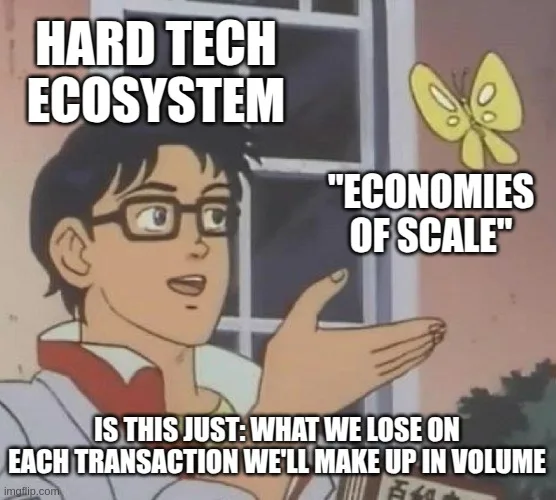
What is going on here?
While it is true that some costs can go down with scale, it is equally true that other costs go up. It’s also true that new processes always have unexpected sources of cost growth during scale up, which is why conventional wisdom, and historical precedent, calls for scaling up after demonstrating positive unit economics.
Hope is not a strategy. At Terraform, we don’t believe customers are prepared to part with their hard-earned money to purchase a steep green premium and that is resoundingly reinforced in the market today. History shows, however, that we will have no difficulty selling a green dividend. Superior value rules. This means that any new process needs to actually deliver value to its customers, ideally from day one.
Ongoing declines in solar PV module costs are the single most extreme value generation opportunity that has ever occurred to humans, and business models that exploit this steady progression need to find some way to get the unit economics the right way up at the beginning. It turns out that capital has a finite appetite for billion dollar experiments.
Superior Value Rules the Day
The hard tech startup landscape is littered with companies that raised millions, built promising pilots, and ultimately failed to cross the chasm from ideation to commercial viability. Successful hard tech ventures don’t wait for perfect conditions or unlimited capital. They engineer paths to market that generate revenue while proving their technology and hacking their way to success. The difference between breakthrough technologies that change the world and those that remain perpetually “promising” often comes down to strategic choices made in the earliest stages that separate the commercial projects from the science projects:
- Find a Beachhead Market: Don’t aim for a massive plant before proving the economics at a smaller, profitable scale. If the tech is wildly out of the money at pilot scale, iterate until it isn’t. Identify niche applications where your technology provides immediate value. SpaceX, for instance, didn’t start with Mars colonization; it began with Falcon 1 and Falcon 9, servicing smaller satellite launches that provided revenue to fund larger ambitions. Terraform Industries follows a similar approach with modular synthetic fuel production units to generate revenue at smaller scales before expanding.
<!-- -->- Generate Cash Flow Early: The belief that hard tech requires billions in upfront capital before reaching ramen profitability is flawed. The companies that succeed start by dominating a valuable niche and scaling from there. Terraform follows this principle by ensuring that each deployment of synthetic fuel production generates revenue, avoiding the trap of infinite fundraising cycles.
<!-- -->- Avoid the Capital Trap: More funding is not always the answer, nor is it an excuse for why you can’t otherwise succeed. Overcapitalization leads to bloated company structures, consumption of resources by inefficient internal interfaces, slower iteration cycles, and a lack of urgency. Stay lean, and let demonstrated success drive capital inflow.
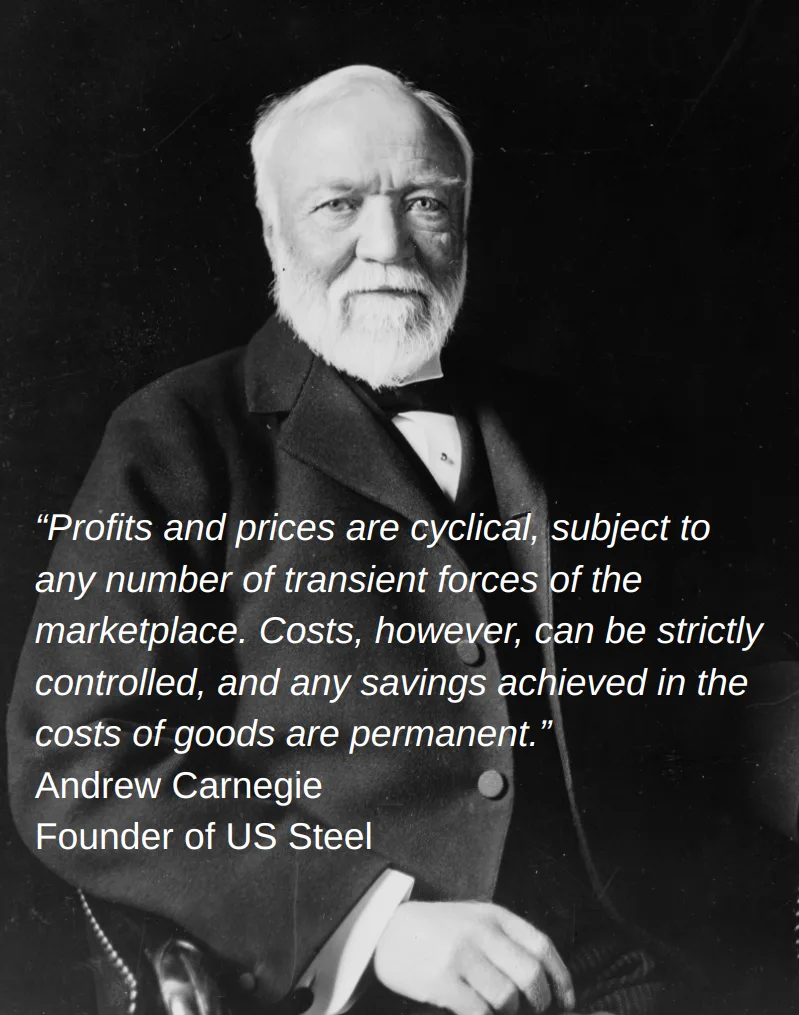
<!-- -->- Prove Real Unit Economics: Fancy Excel models don’t substitute for actual cost reductions. If a process isn’t cost-competitive in the pilot phase, it likely won’t be at scale either. Companies that master efficiency at small scale and grow sustainably avoid the common scaling trap.
Execution Over Excuses
Winning in hard tech isn’t about waiting for perfect conditions—it’s about psychotic determination to execute, iterate, and provide value every step of the way. The companies that have succeeded in reshaping industries didn’t do so by relying on external lifelines; they did it through relentless focus, superior execution, and an uncompromising commitment to delivering real value.
Too many hard tech ventures fall into the trap of believing that capital, policy, or luck will determine their fate. But history shows that the companies that dominate do so because they build cultures of engineering excellence, operating efficiency, and financial discipline. This is not about creating grand visions without a foundation—it’s about making meaningful, measurable progress every day, ensuring that every dollar spent generates tangible returns.
Terraform Industries is operating with these principles at its core. Just look at our website! Our approach to synthetic fuel production is not dependent on subsidies, speculative capital, or vague promises of future economies of scale. Instead, we are methodically proving our technology at small scale, delivering real economic returns, and scaling only when the economics justify it. We are not just theorizing about the future of energy—we are building it and we need a lot more people to help us get there.
We have opportunities in all aspects of our business, including mechanical engineers, electrical engineers, technicians, business specialists. To work with us, shoot us a compelling one pager!