
The Core Pillars at Terraform Industries
A conversation with Lucie Nurdin, the reactor lead at Terraform.
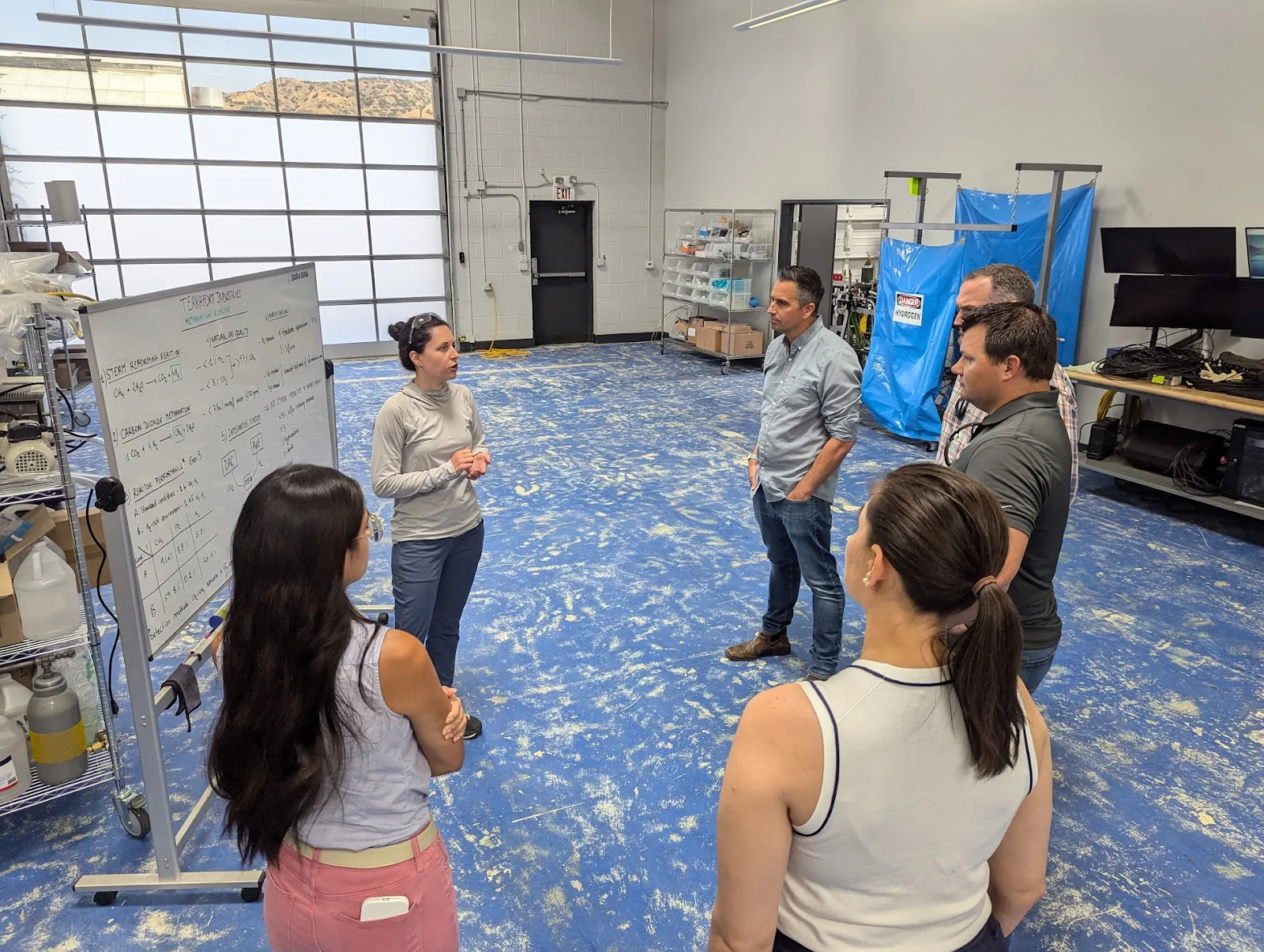
I knew the moment we first met you were a very unusual person. When did you realize that … you weren’t like the others?
That’s an interesting question. What’s unique about me is that I never adhered to the conventional tradition or stereotypes of my generation. While my female cousins were playing with dolls, I was reading books on how to become a scientist and the impact that scientific research has on the world. Marie Curie was my north star, while the cutest pop singer was the one for most 8-year-old girls of my school. Ultimately, I joined Terraform because I knew it was unique and it would allow me to test the limits of my ambitions. But I grew up in a pretty isolated environment and didn’t recognize that my attitude was unusual until later in life.
Tell me about your childhood.
I come from a very small village in Bourgogne, (Burgundy in English), located in the middle of nowhere, pretty flat, in France. I grew up on a flower farm that my dad built when he was 17 with his brother, a family-owned business. I spent the first 18 years of my life working at the farm in all my free time: taking care of the flowers, chopping trees, building irrigation systems so my uncle didn’t have to water 10,000 plants every day by hand, or just selling the flowers and answering people’s questions: any type of advice they would need about sun, shade, what comes back every year, what to use for their garden.
During that time, I was also pretty curious, and I realized we had some unforeseen events happening at the farm that my dad couldn’t explain: severe drought and wind that took out the greenhouse. “In 30 years that I’ve done this business, I’ve never seen this before,” he would say (in French, of course). I asked myself why. At school, my science teachers were pretty adamant about answering some of these questions. The answer was climate change.
I decided that I was going to dedicate most of my life to solving that problem. At 18, I left the farm and went to the big schools in Paris to study maths, physics and chemistry. I fell in love with chemistry, which is one of the most applied sciences.
When did you realize that you had the ability to contribute to the sum total of humanity’s knowledge?
Before I signed up for my PhD, I was curious about everything. I didn’t have the maturity to sit down and actually think beyond myself. Only when I realized that the work I could do could benefit both me and others did I look outwards and shifted toward contributing to society.
What were the basics of your PhD?
I started my PhD in September 2015 at the University of Calgary in Alberta, Canada, under Dr. Warren Edward Piers, a very well-known inorganic chemist who specializes in understanding how reactions take place. My contribution was to take a new family of molecules that employed Earth-abundant metals and study them for alternative energy reactions. Most chemical transformations are made using rare metals that are expensive and finite. Could iron drive the same transformations? Could we modify the conditions to make it work? (Spoiler alert: Yes.)
How long did it take?
Five years, including the COVID pandemic which made it a good time to finally write my thesis.
What did you learn beyond the pure details of chemistry?
How to be organized, detail-oriented, persevere, and understand when a project had to be cut off and rerouted from one path to another. These are the meta tools of the trade. I also learned how to mentor people and educate the next generation of scientists coming through the university, not only teaching them in courses but working with other folks in the lab with me.
How did the mentoring you did in your PhD compare to managing the reactor team at Terraform Industries?
My PhD gave me a basic understanding that the fundamentals of mentoring and management come back to taking care of the human side first, before the technical experience. You can’t teach people without realizing that they are humans.
From then to now, it’s the same thing: Make sure people are heard, understood, have correct directions, and that you care for them. If you don’t do that first, you can bombard them with technical directions, but they will lack trust and won’t be receptive. You have to establish a relationship based on trust first. Without that, nothing else matters.
What other activities depend on trust?
When I met my husband, he was (and still is) crazy about extreme sports. So I got into skiing and rock climbing. Both require (and challenge) the ability to make the right decisions, and trust your partner with your life, literally. It’s the same way you trust a pilot to fly the plane. You haven’t interviewed them before, but you trust they care enough for the passengers to make the right call.
Sometimes rock climbing is terrifying. You could be protected by a rope but still risking a giant pendulum or breaking a hold. If you fall, you could take a giant whipper 30, 40, 50 feet into some adjacent rock face. Sometimes it’s very focusing, especially in a no-fall zone. Like engineering chemical reactors, climbing is a team-based cerebral risk management exercise, not just screwing around trying to die.
What happened after your PhD?
In my 4th year of grad school (2019), I went to a conference and learned about using ammonia as a synthetic fuel. There was a groundbreaking study published in Science that someone presented and I got inspired. Could ammonia become, indeed, the fuel of the future? I decided to go back into the lab to see if the molecules I’d been working with could be used for ammonia activation, which they could. The brief highlight of my last PhD work was that Earth-abundant iron can be used for ammonia oxidation. This is necessary because burning ammonia can create NOx, an air pollutant, so first we want to catalytically decompose it so we only burn the hydrogen part.
But we also need to make green ammonia in the first place. Synthetic ammonia was invented in about 1912, through the Haber Bosch process, but it’s still an incredibly energy-intensive industry. I had a desire to continue my career in academia, which requires going through a big university in the US. I applied to Caltech, was accepted to work in Jonas Peters’ lab in chemistry, and worked there for two years on the electrification of ammonia synthesis directly from nitrogen and water.
How did you find out about Terraform?
The most unusual referral ever. I went rock climbing at Black Bluff, a very tiny wall close to Big Bear in California. I was at the base of the route with three other guys who were also rock climbing. Their belayer started talking to me, asking basic questions. Who I was, what I did, whether I was looking for a job. Maybe, I said. Why? He was working for a small startup currently looking for a chemist to help with a carbon capture and utilization project. That’s how I met Graham Kersey. This happened on a Saturday. On Monday, I received a DM from Casey asking if I was available for a chat.
Then what happened?
I went through the interview process, probably one of the first 10 people interviewed at Terraform. It was very exciting once I realized that I wanted the job and was ready to leave academia. Now the shoe is on the other foot, since I’m doing so much interviewing to continue building the team at Terraform.
What’s Graham doing now?
He’s building Mechazilla at Starbase. He really enjoys the “high angle” work. But secretly I know he misses Terraform Industries.
You often talk about your five core values, what are they?
I’ll list them and then unpack them one by one. Safety First. Dedication. Organization. Team Spirit. Honesty.
Safety First: How should you approach safety in such a high-risk environment?
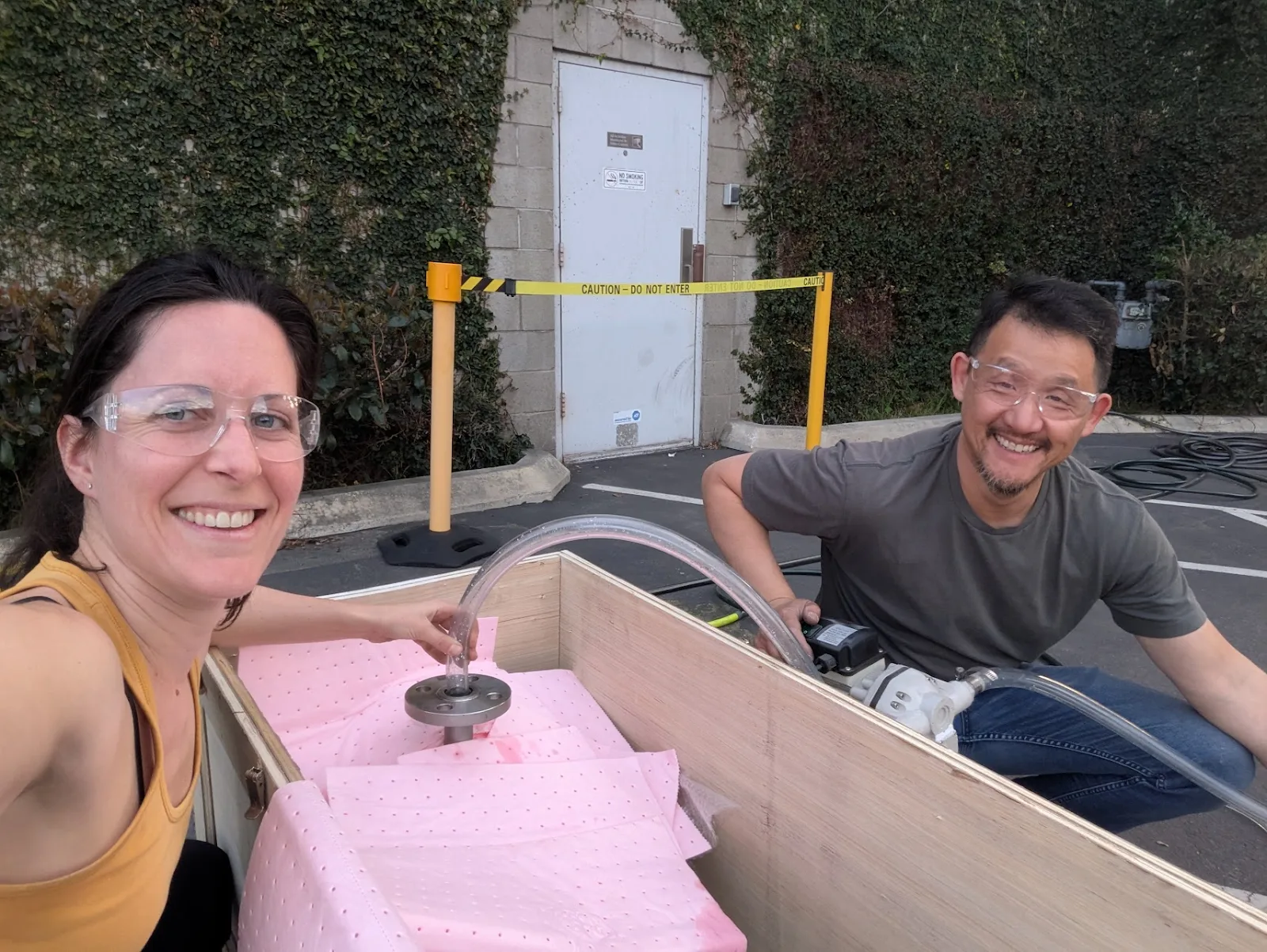
Working in a chemistry lab and rock climbing have taught me that nothing can justify cutting corners, being complacent, or ignorant. At Terraform, I was, until recently, the safety officer, and my role since Day 1 has been to build a strong, positive, and successful safety culture. Prevention and education are key to achieving these goals. However, too much safety prevention and training can lead to zero progress, and that’s not helping anyone either.
That’s why I decided to empower everyone at the company to share in our safety culture and actively participate in it. I’m not running around with a police hat telling people what to do. Instead, I use my expertise and that of my colleagues to educate each other and exchange knowledge about safety hazards, risk assessment, and mitigation. When near misses or incidents occur, because they inevitably do, we learn from them and do better. We iterate. So far, I’m proud to report that the worst thing that’s happened in our hardware shop is a badly bruised thumb caused by a dropped wrench.
Dedication: What drives our passion for synthetic fuels?
I cannot dedicate myself to something I’m not passionate about. How did I become passionate about making synthetic fuels? It seems counterintuitive, and it was initially after spending years looking for alternative fuels to replace hydrocarbons. During my PhD, I worked on nitrogen-based fuels and other fuels that wouldn’t create carbon emissions. I joined Caltech with the hope of making green ammonia a reality.
All of these projects were fantastic to work on, and I do believe they will become a fundamental pillar of our energy system. But unfortunately, they require years, decades of development to reach the industrial level of hydrocarbons. Additionally, most of them are currently, one way or another, derived from fossil energy.
We have three problems to solve that are tightly intertwined:
- Our society requires a continuous flux of energy, and this energy demand will continue to grow.
- Because of our linear relationship with carbon—we extract it from the ground, burn it, and it stays in the atmosphere—our energy crisis is quite literally fueling our climate crisis, and we’re running out of time to do anything about it.
- Renewable and most “green” energies do not meet the requirements of continuous energy supply, meaning our energy transition is slow and expensive.
Casey Handmer, founder of Terraform, realized this years ago and proposed a solution to bridge two worlds that interact very little: making cost-competitive synthetic fuels using excess solar energy that would otherwise be wasted. We’re bridging the gap by making the same molecule that comes from the ground, but instead, we’re using captured carbon dioxide as our feedstock. We solve all three problems: we’re not fueling our climate crisis; on the contrary, we’re recycling CO2, we’re using renewable energy, and we’re providing the world with cheap and continuous energy.
I’ve been excited about accomplishing this goal since Day 1, and I’ve been dedicated to our mission and to sharing it internally as well as externally.
Organization: How do you manage the complexity of your role?
I see organization like a chess game: I need to be three moves ahead to stay in the game. I’ve been playing the game for a while, so experience helps here. Google Calendar, spreadsheets, roadmaps, whiteboards, sticky notes, clear communication, and clear expectations are all the tools I use to win the game. So far, it’s paying off.
Team Spirit: What’s your philosophy on collaboration?
The most rewarding experience of maturing was when I realized I didn’t have to be the best all the time and work alone. You can have five individuals working on their own projects, or you can have the same individuals working together to tackle a giant mountain. I’m convinced that the big problems at TI, and in general, can only be solved if we work together, share ideas and opinions to come up with the ultimate solution.
I keep repeating this, but we’re not competing with one another. The only competition out there is climate change and our energy crisis that urgently need to be solved. I’m proactively building team spirit at TI: I give each member of my team the opportunity to provide feedback, share ideas, and be part of the decision process. Ultimately, I find it most rewarding when my team accomplishes a big project together and gets to share the success thanks to collaboration.
Honesty: Why is direct communication so important to you?
People don’t know if you don’t talk to them. To the best of my knowledge, no one can read minds. That’s why I pride myself on honesty, in giving people feedback and having honest conversations. Clear communication and avoiding buildups is crucial for a small startup to survive. We’re spending 8+ hours a day together, we’re building relationships, and it takes honest and constructive feedback to get to an A+ team.
That’s a great set of values to bring to work. What have you learned here in the last three years?
Five more values I learned at Terraform are: Delete. Simplify. Spend Money. Iterate. Think Big.
Delete: How does this principle work in practice?
The first question during our design reviews is: “Why do you need this part/system/valve?” If you cannot justify it, then you delete it. This concept is easy for me to adhere to from a minimalistic mindset, since it’s akin to “refuse, reduce, recycle.” But for many engineers, this is extremely counterintuitive, as many tend to solve complex problems with complex engineering solutions.
One example of this in reactor design concerns mass flow controllers. This is an expensive and finicky part that is used to meter precise ratios of reagent gas flow into the reactor. Casey had always insisted that we delete this part to reduce cost and improve reliability. It was a scary step to contemplate but we have ultimately been successful in obtaining this functionality from other components that are needed anyway.
Simplify: What does “good enough” mean at Terraform?
Our machines only need to be “good enough.” Let me explain. One hundred years ago, we developed the lawn mower. Roughly speaking, it has a blade, two wheels, and a handle, and more importantly, it gets the job done cheaply: cutting the grass for $50. Over 10 years, that’s a cheap machine. Sure, it’s not the most efficient device out there, it might leave 10% of uncut grass, but who cares?
These days, electrical lawn mowers with cameras and motion sensors are flooding the market, costing two orders of magnitude more than the good old manual lawnmower. While most engineers would think that the electrical, fully automated, more efficient lawnmower is a great advancement, we at Terraform Industries see this as an over-engineering solution. Delete parts, maintain simplicity to get the job done as fast as possible.
Over the last 100 years, enormous quantities of effort have been expended on catalyst research and design, including my own PhD work. There are at least a dozen catalysts that can perform the Sabatier reaction we use to make methane from sunlight and air. Some of them are extremely exotic, containing all kinds of rare and expensive herbs and spices and achieving spectacular, albeit not exactly robust, performance. At Terraform, we adopted the oldest, simplest, cheapest, and most robust catalyst, because we can engineer around its shortcomings and then have total confidence that it won’t be poisoned by some parts-per-billion contaminant.
Spend Money: How does this philosophy change the development process?
When I interview folks, one of their pet frustrations is how long it takes to procure anything. When I ask “How long did this take?” they often respond, “Weeks, because I needed approval to order a $150 part.” Right there, we’ve deleted this delay at Terrafrom. We have a company card and we spend money to save time or save CAPEX.
From before I started working at Terraform, Casey had written our monthly, weekly, daily, hourly, and minutely burn rate up on a whiteboard, both on a company basis and a per person basis. We constantly remind people to recalibrate their intuitions about saving money vs time. We love nothing more than a nasty technical problem you can solve simply by spending what might seem like an unreasonable quantity of money.
Iterate: Why do teams get stuck in analysis paralysis?
Because 1) they want the best solution on the first go and 2) don’t want to fail. At Terraform, I encourage everyone to fail fast, so that we can learn and finally celebrate when we’ve failed enough times to make it succeed. It’s too easy to spend months obsessively listing everything that could possibly go wrong and then getting worked up over trying to retire this risk on paper. It’s far better to build a scale prototype with your hands in the workshop, break it, and learn.
I would rather have my team improve by 4% every month instead of them spending 12 months for a 60% improvement. Both lead to the same improvement amount (60%) but the latter will result in substantially less uncertainty due to the real time nature of iteration and much more accumulated learnings and more constant motivation. On top of this, marginal returns to more “thinking” drop off very quickly in the absence of real world data, while it’s almost always possible to think of some short term incremental improvement, by which you can quickly chain your way to success.
Think Big: What’s limiting you?
I constantly have to remind myself why I do the everyday tasks: because they are a part of the big picture. I joined Terraform because of the huge positive impact it can have on the world. I’m not spending pocket money I’ve made on the farm anymore, I’m responsible for millions of dollars of investment, which will be used to supply the planet with synthetic and renewable fuels. It’s inspiring to realize that a good decision made today might have a 2x impact on outcomes in a couple of years. To get there, though, I have to expand my capabilities and push my own limitations constantly. It takes self-reflection and even listening to feedback.
Is your team too big, Lucie?
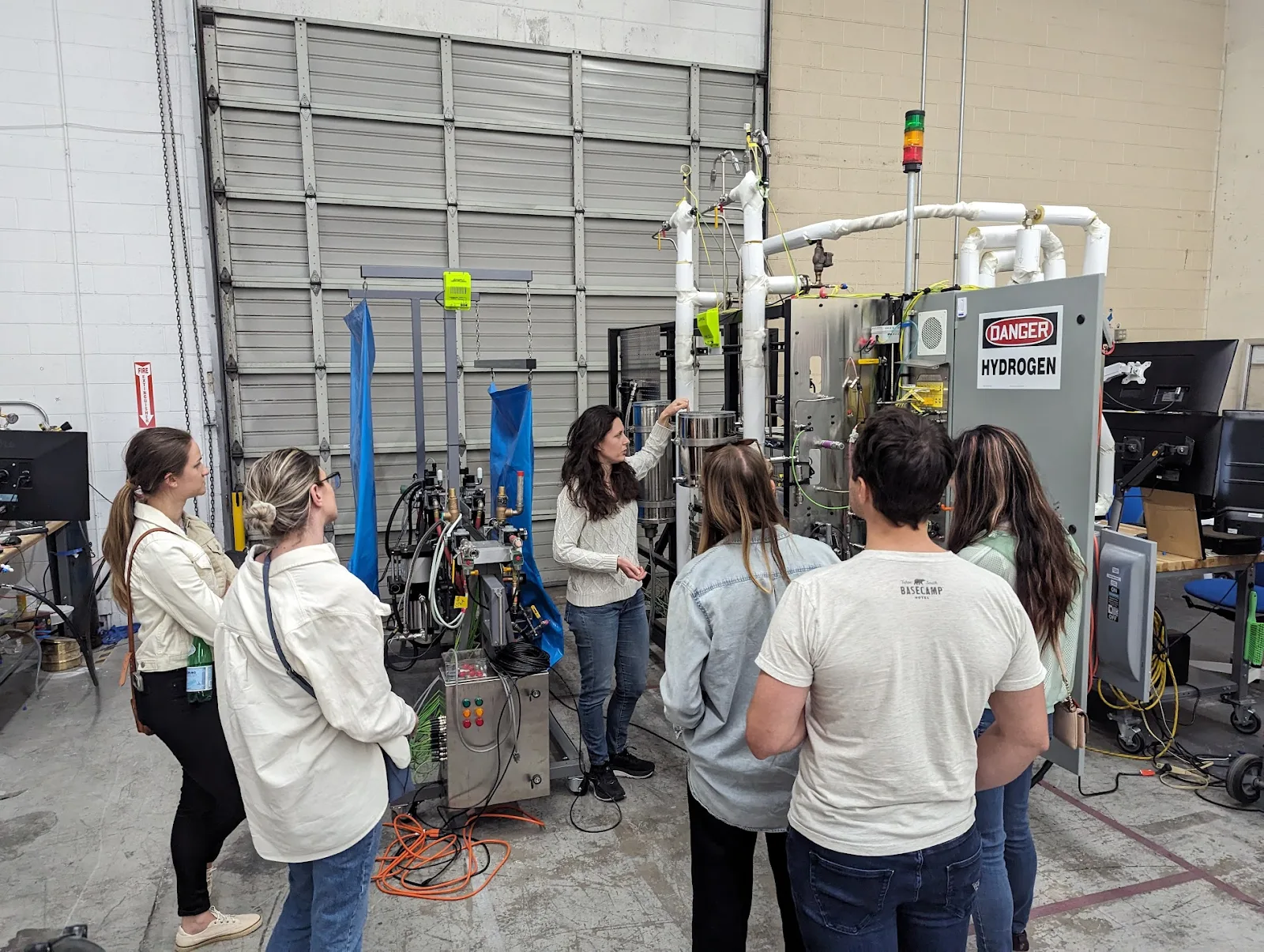
Not at all. We’re hiring for a variety of roles. We have about half a dozen projects in various states of maturity, ranging from an electrolyzer going into mass production all the way down to benchtop scale experiments. We’re currently assembling our first full scale methanation reactor, which will be capable of producing over two million cubic feet of artificial natural gas per year! My team is also looking to ramp up work on a methanol reactor and an ammonia reactor. At the same time, the reactor injection system is a standalone subsystem which can meaningfully absorb more talent. Lots of roles are listed on our website at terraformindustries.com.
What sort of talent are you looking for?
We like people who are ambitious, self aware, and have a track record of success. Terraform is, I think, the best place for people to rapidly level up their skills and really test what they are made of. We reward ambition, competence, and growth. We’re actively inventing an entirely new primary material production layer, one that is independent of fossil fuels and thus future proof. I’m confident that in 10,000 years, humanity will derive their stable material abundance from the foundations we’re developing here.
Any final words?
From a flower farm in Burgundy to synthetic fuels in the Mojave—this is what relentless dedication to solving climate change looks like. If these values resonate with you, maybe you should be building with us.