
Terraform Talent Development
Terraform Industries is the vehicle by which I build the people that build the team I need to build the future I am determined to build.
One of the unexpected privileges of founding an ambitious, future-oriented hardware company is that I get to hire, mentor, and develop ambitious people to become the leaders of tomorrow. Earlier this year, I formalized this process and today I’m externalizing this memo.
Why? To better prepare candidates for the challenges ahead, to share our insights into organization, and to strengthen the culture of American re-industrialization. There is no supply of hardened, seasoned veterans of synthetic fuel production, yet. We get to build them from scratch.
Join Us
Terraform is the best place for ambitious, hard working people to become the best they can be.
Terraform has a range of positions for early, mid, and late career mechanical, electrical, and chemical engineers and technicians, and allied trades. Incredible opportunities for growth, leadership, and worthy challenges in carbon capture, hydrogen electrolysis, methane and methanol synthesis, as well as nascent efforts on metals, cement, and desalination.
To conquer the primary energy consumption layer of our civilization, check out our open roles and apply at hiring@terraformondustries.com.
More Context
Here are some other useful posts on career development. I like the LLM-induced trend of putting only relevant references up top.
Career Development Guide For Job Seekers
Maximizing Resume Signal Noise Ratio
Stuff You Should Have Learned By Now
You Should Be Working On Hardware
The Company As A Machine For Doing Stuff (Packy McCormick)
Terraform Development Responsibilities
Engineers build tools to perform otherwise impossible tasks. A tool can be a hand, a screwdriver, a line of code, a fixture, a jig, an injection mold, a factory, or an org chart. The tool is the mechanism by which an idea is made real.
Career development is meta-tooling. Terraform as a whole, and your team and responsibilities within it, are intended to be the best place on Earth for you to become the best you can be.
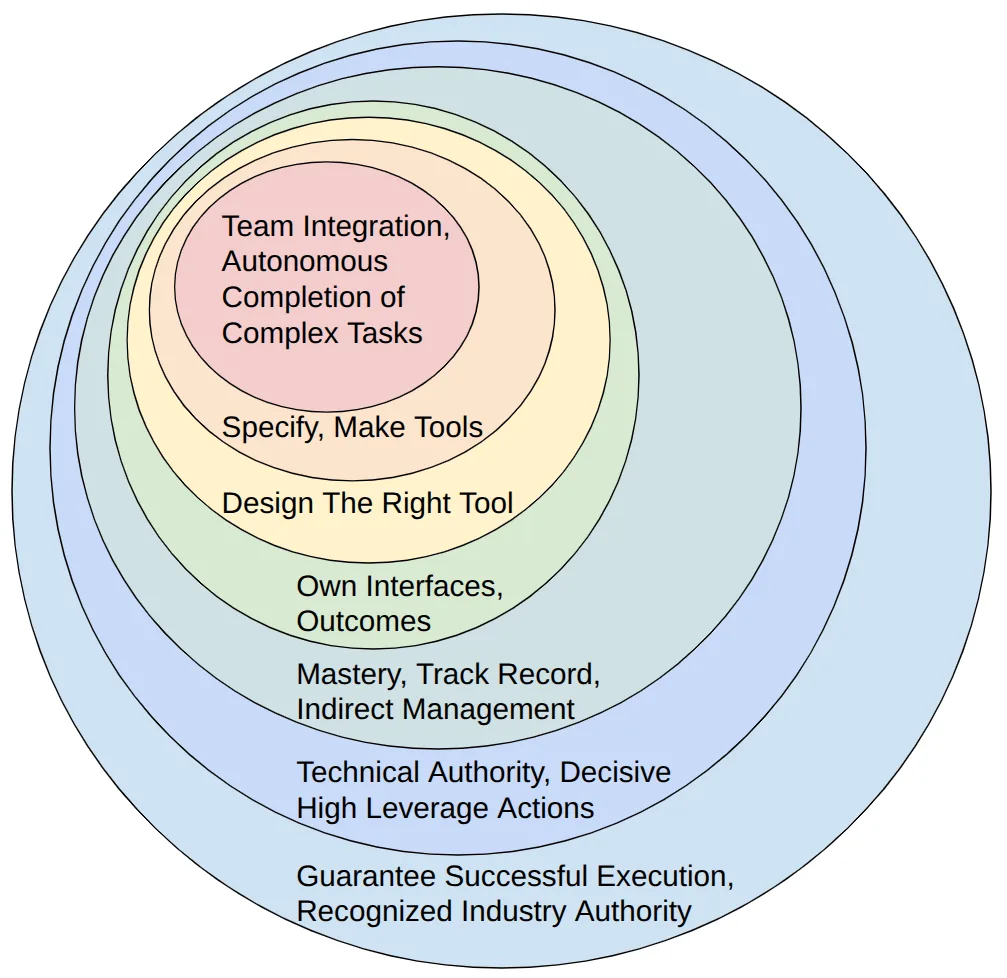
As Terraform continues to grow, we need to ensure that job expectations continue to be explicit. The following levels provide a map for your development and the intensification of capability. They are intended to function as a cursus honorem, allowing any employee to easily see how to make the most of their time and opportunities here.
The job ladder provides visibility into both technical and managerial tracks, but at Terraform, we strongly encourage people to develop these mindsets in parallel. Pay increments are roughly 10% per level, and we expect people to climb a level in no more than a year. This is explicitly “up or out.” Stagnation is not an option.
The following is not an exhaustive list of expectations. The job titles here map to broader industry titles, and not Terraform job titles, which we prefer to make more descriptive. The increments in capability and authority are intended as a guide for career development conversations at Terraform.
Leadership
Terraform provides early opportunities to take on leadership responsibilities and develop skills. Leadership skills are unintuitive, enormously valuable, and may be readily improved through practice. All leaders must be able to:
- Build the team: Recruit, mentor, hold accountable, and drive.
- Set the direction: Lead, motivate, explain, consult, and build consensus.
- Don’t run out of money: Sell, advocate, and understand the needs of the customer.
Some organizations prefer to hire specialists to offload some of these skills, such as sales or recruiting. People in these organizations assume that their job requires them to only handle their specialty, and their skill atrophy in other areas. This is deeply career limiting. Even if your company has a sales org, you still need to understand how sales works, because it’s how you attract top candidates, get credit for your work, drive consensus around your ideas, and secure resources.
At Terraform, we generally don’t hire non-technical specialists, because our most critical interfaces are with other technical people, and we don’t want to dis-intermediate that information exchange. Instead, everyone gets to learn about traditionally “non technical” functions, greatly expanding the scope of their competence.
Each of the levels below requires aggressive development of all of the skills associated with leadership to progress, in addition to the steady in-sourcing of responsibilities and growth of scope described.
Levels
Table stakes at entry level
- Integrating with the existing team. It is non-trivial, requiring a high degree of technical competence, insight, and self-awareness. Must also have sufficient ambition and determination. Remember, action precedes motivation. Enjoyment comes after sweat.
- Can successfully complete basic tasks given detailed instructions.
- Can successfully complete basic tasks with basic instructions.
- Can successfully complete more complex tasks with detailed instructions.
- Can successfully complete more complex tasks with basic instructions.
- Can autonomously complete complex tasks.
First promotion
- Can oversee small teams. This includes providing coaching and instructions to other less experienced team members, and taking responsibility (and giving credit) for the successful completion of their deliverables. It also includes knowing how to communicate information people need to build stuff.
- Can specify tools to solve problems. “We need a widget that can do X.” “We need Salesforce/CRM.”
- Can make tools to solve problems. “I found this design for a widget, I’ll make it.”
Engineer II, Senior Lead
- Can design tools to solve problems. “I designed this new widget to solve a problem.” Note that reusing old solutions is often better than designing new solutions, and knowing when innovation for its own sake is not necessary is a key judgment skill needed at this level. On the management side, responsibility grows to include outcomes, not just component delivery. That is, the senior lead delivers not just the component, but the solution the component is meant to provide. This requires the ability to see through the text and through reality to the solution space. It is important to cultivate the intuition necessary to judge what is necessary, or what is a viable path. Constraints often force an even better design.
Lead Engineer, Team Lead/Manager
- Can oversee sub-systems. This is a more product-focused role than small team or component management, because here the person has visibility into their team AND interfaces with other teams, and has to intuitively understand what their customers need, not just what they say they need. At this level, the lead has responsibility not just for a component but for a product. The role includes product management aspects, that is, responsible not just for the success of the product in terms of function but also in terms of intended use cases and interfacing with the customer. This is also the level where outcomes are consequentialist. At level 11, the Lead guarantees an outcome and they are not graded on effort. A team lead/manager also has considerable responsibility for talent management, that is to say, recruiting, hiring, performance management, and career development. The team lead is expected to remain the supreme technical authority within their vertical and have the ability to operate authoritatively in adjacent verticals.
Senior Engineer, Senior Manager
- Mastery of a topic area, such as a particular manufacturing stack, design language, analysis tool set, regulatory framework, enterprise sales, etc. Eg tool & die, thermo/fluids, statics, etc. This level is table stakes to spend a career working on really interesting stuff. The manager has a high level of confidence in successful execution of any project, and has typically demonstrated a track record of success. At this level, the manager also begins to manage managers, a critical but very challenging transition and one that enables the operation of much larger projects.
Staff Engineer, Associate Director
- Company authority on a particular area. The manager remains deeply technical but interfaces primarily with managers, and has developed competence in correctly intuiting issues and decisively addressing them, so as to maintain a high degree of leverage in keeping projects of large scope on track. They have comprehensive knowledge of every aspect of development they supervise, play an active role in developing junior talent, and make swift and correct decisions.
Senior Staff Engineer, Director
- An industry authority on a particular area. In addition to the above, they have an established track record and likely a public profile. They have developed the skills necessary to move into any project set and get things right. They assume total responsibility for successful execution.
Principal Engineer, Senior Director
- World authority on a particular area. “There are 10 people who might know more about this than I do, and we’re all in the same group chat.” This may also be thought of as a transitional role into an executive-style role.
Reading List
Fortunately, we don’t have to do this in a vacuum. Millions have gone before us. Thousands have written their stories. Dozens are comprehensible and useful. Speaking of which, you should definitely write a blog. I know of no better way to increase your luck stat.
“If I have seen further it is by standing on the shoulders of giants.” Isaac Newton 1675 to Robert Hooke, a predecessor of rather short stature.
In our quest to maximize our rate of skill development, we need to aggressively consume hard won lessons by others. You should develop your own programs of reading or other meaningful media consumption to level up. LLMs can help here by listing and ranking dozens of primary sources according to your preferences. I have found that first person technical accounts are about 100x more interesting and useful than researched histories by non-technical historians, in terms of actionable knowledge for real world leadership of technical programs.
The purpose of reading is to challenge your assumptions and biases, and improve your internal world model and intuition so that you can make correct decisions more quickly and more often.
Safety
NTSB aviation accident investigation database
NTSB YouTube
The Killing Zone: How and Why Pilots Die (Paul A Craig)
Into Thin Air (John Krakauer)
Touching the Void (Joe Simpson) (also a film)
Normal Accidents (Charles Perrow)
Aeronautical decision making
Checklists
Columbia Shuttle Disaster report
Challenger Shuttle Accident report
Normalization of Deviance
Chemical Safety YouTube
178 seconds to live (controlled flight into terrain)
Steam leak horror stories (reddit)
Therac-25 software safety escape
Flying Blind (Peter Robison)
Dittemore’s Law (Casey blog)
Mark 14 Torpedo problems
TWA Flight 800
Hyatt Regency Walkway Collapse
2021 Champlain Towers Condo Collapse Report Critique
Leadership
Poor Charlies’ Almanack (Charlie Munger). Founders podcast summary
Pieces of the Action (Vannevar Bush)
More Than My Share of it All (Kelly Johnson)
Now It Can Be Told (Leslie Groves)
Rickover Effect (Theodore Rockwell)
Zero to One (Peter Thiel)
Hard Thing About Hard Things (Ben Horowitz)
Founders (podcast)
Founders: How Elon works
Founders: How Jensen works
Acquired (podcast)
– VISA
– Costco
– Enron
– Amazon
– Walmart
– Google
Cost of glory (podcast)
Stuff you have to know (Casey blog)
Maximizing resume SNR (Casey blog)
Well rounded engineer (Casey blog)
Patio11 on COVID vaccines (Patrick McKenzie blog)
How NASA Builds Teams (Charles Pellerin)
Only The Paranoid Survive (Andy Grove)
High Output Management (Andy Grove)
Mythical Man-Month (Fred Brooks)
The Elephant in the Brain (Simler and Hanson)
LOTR (also the films)
Thunder Below (Eugene Fluckey)
The Lean Startup (Eric Ries)
Extreme Ownership (Willink and Babin)
Mr Beast onboarding memo
The Sunion
Skunk Works (Ben Rich)
Play Nice But Win (Michael Dell)
Healing Back Pain (Sarno)
On Responsibility Essay (John Grier Hibben)
Lessons of History (Will Durant)
How the world really works (Vaclav Smil)
Physics and Science
The Art of Doing Science and Engineering (Richard Hamming)
Halliday Resnick and Krane (Physics Text)
Casey’s Physics Olympiad notes
Problem Solving Algorithm (Casey blog)
Structures: Or Why Things Don’t Fall Down (J. E. Gordon)
AvE YouTube
Munro Live YouTube
Ultralearning (Scott Young)
Why We Sleep (Matthew Walker)
Feynman Lectures on Physics
Alchemy of Air (Thomas Hager)
The Pattern on the Stone (Danny Hillis)
Are there any truly terrific books I’m missing? Send your suggestions!